Privacy preferences

Strictly necessary

Always on

Remembers your choice on this page. Stored in your browser as gb_consent for up to 6 months. If you switch the site to dark mode, that choice is kept as gb_theme. Nothing is sent to a server.

Anonymous analytics

Helps us count visits. At most once every 24 hours we send one ping to our own telemetry server, using the same anonymous approach as the WeightsLab package. No advertising, no third-party trackers, no cross-site tracking.

Exactly what is sent
uuid
A random ID created in your browser (gb_tid). It is not linked to your name or email.
event, version
website_visit and website, so website visits can be told apart from WeightsLab package pings.
os
Operating-system family only, for example Windows, Darwin, Linux or Android.
tz
Your time zone, for example Europe/Paris.
On our server
Your IP address is used to estimate country and city. Only a salted hash of it is kept, never the raw address.
GitHub star count
With analytics on, your browser also asks api.github.com for the public star count of our repository, so GitHub sees your IP address. With analytics off, the page shows a fixed number and makes no request to GitHub.

Turning analytics off deletes gb_tid and stops all pings.

Results · live in our sandboxes

What we run in the sandboxes.

Four setups you can try, from a toy case to robot manipulation to LLM data. In each one you look at the samples, find what the model gets wrong, and change them while it trains.

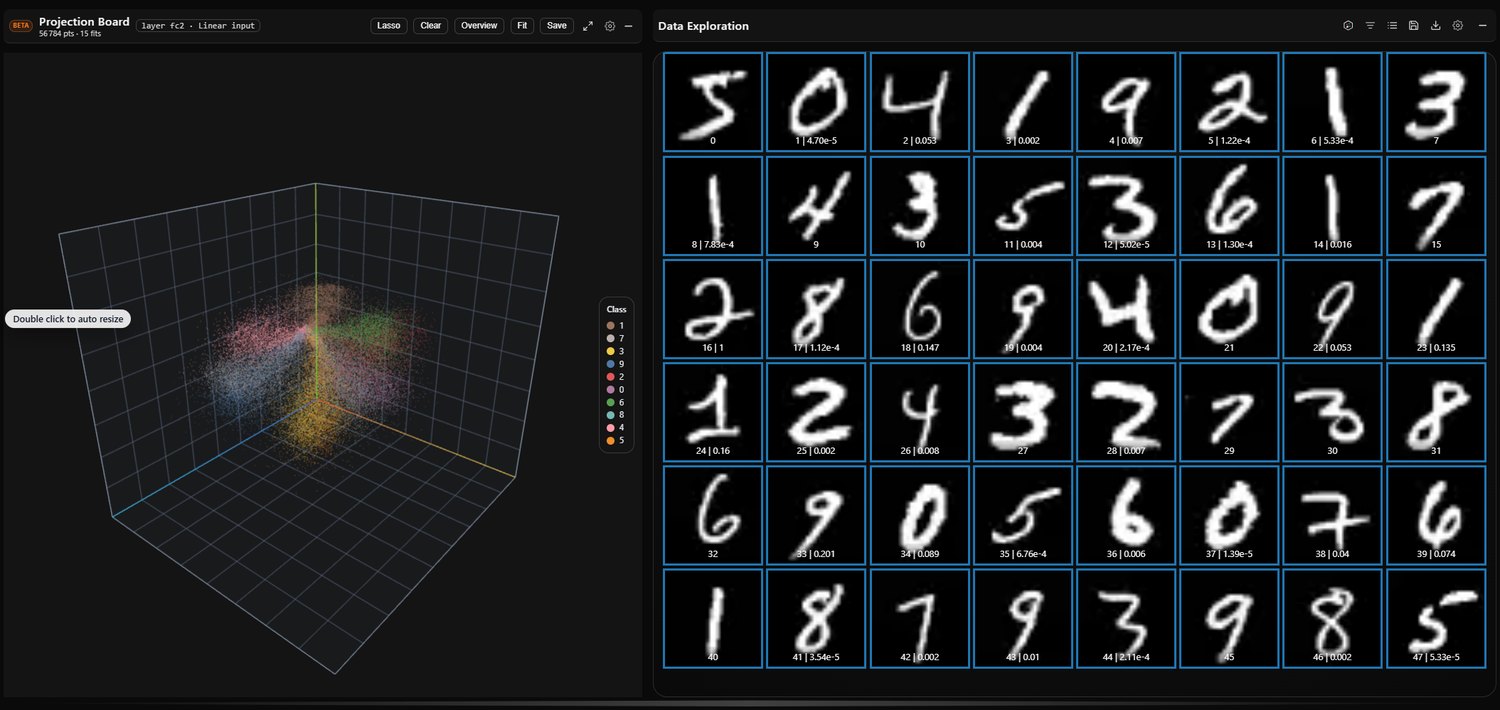
WeightsLab on MNIST: a 3D projection board of the training samples next to a grid of handwritten digits, each labelled with its per-sample loss

The toy case · Classification

MNIST: small enough to watch every effect

A CNN digit classifier, trained live in the sandbox.

  • Per-sample loss streams in as the model trains
  • Tag the hard examples as they show up
  • Watch the deny-aware sampler focus on them in real time
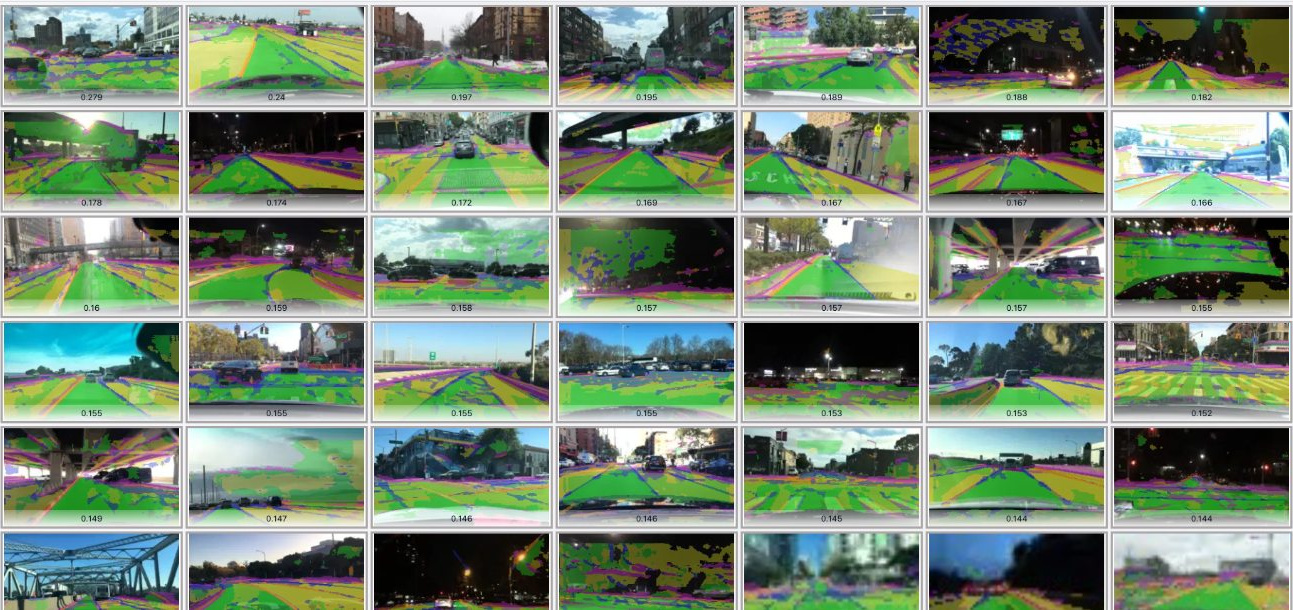
WeightsLab on driving scenes: a grid of road images with segmentation overlays, each labelled with its per-sample loss

Driving perception · Segmentation

BDD: per-pixel segmentation on driving scenes

Semantic segmentation with a LiteNet UNet, on real road images.

  • Inspect per-sample IoU and mask overlays in the studio
  • Sort by loss to surface annotation errors and hard scenes
  • Tag, drop or re-annotate samples without restarting the run
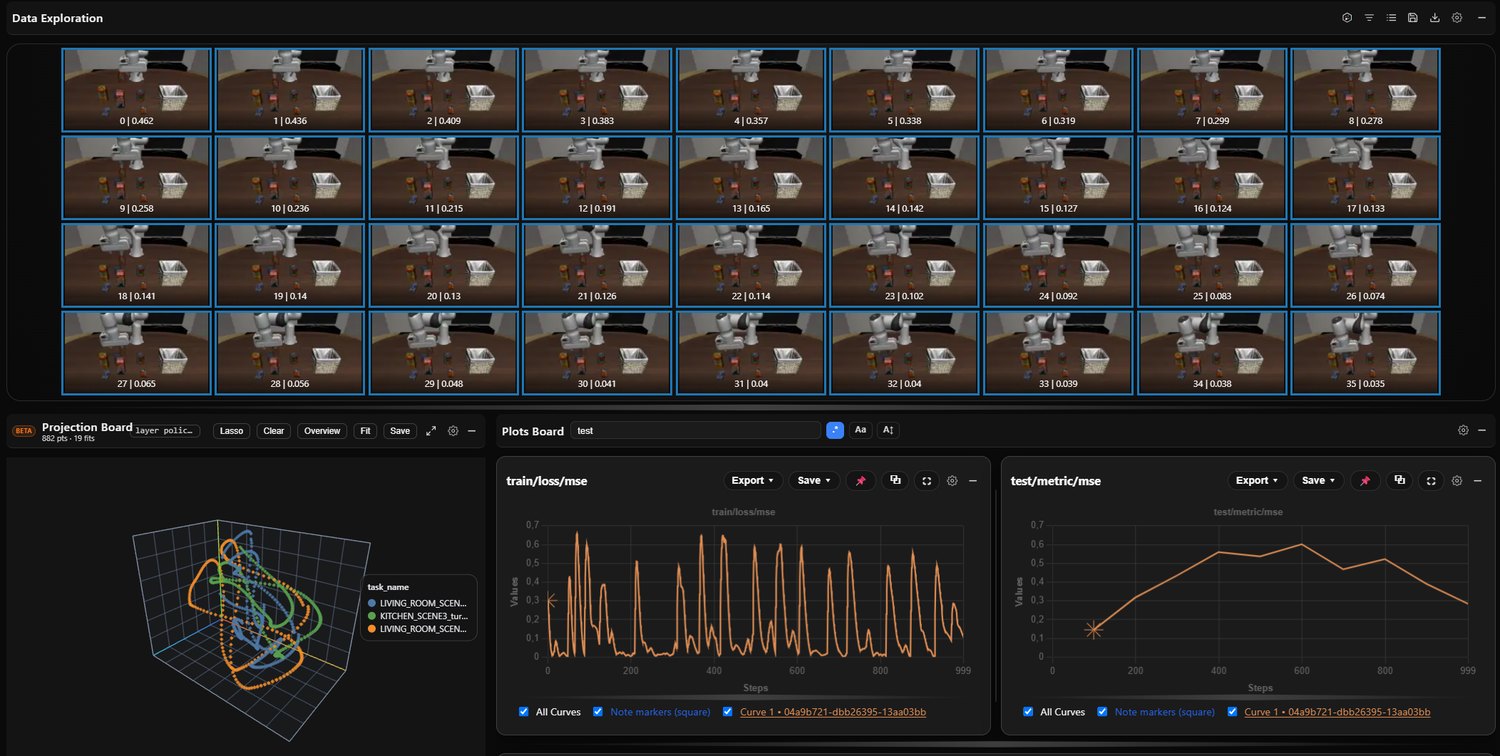
WeightsLab on robot manipulation: a grid of camera frames from the LIBERO dataset, each labelled with its per-sample loss, above a projection board and the train and test loss curves

Physical AI · Robot manipulation

VLA: OpenVLA on LIBERO

A vision-language-action model on the LIBERO robot-manipulation dataset.

  • 2D mode: a single frame in, the next action out
  • 3D mode: a whole episode in, the full action sequence out
  • The same sample-level workspace as for vision

LLM data · Human preference

LLM: which answer would a human prefer?

Chatbot Arena battles from Kaggle's LLM Classification Finetuning challenge: given a prompt and two anonymous answers, predict the preferred one.

  • Each battle is a row: sort by loss and read the prompt and both answers inline
  • Check whether the model learns real preference or just the length bias
  • Length, formatting and refusal features become sortable columns

The live sandboxes open after a quick identification step: sign in, or request access with your email.

Our target

Up to 95% less training data

The same performance from a fraction of the data, and less compute to go with it.

See it on one of your runs.

Try the sandbox in your browser, or book 30 minutes with us and bring a real run.

Join the early-access programme

Tell us what you train and we'll get back to you with a demo and licence terms.